Build Different
Conference50min
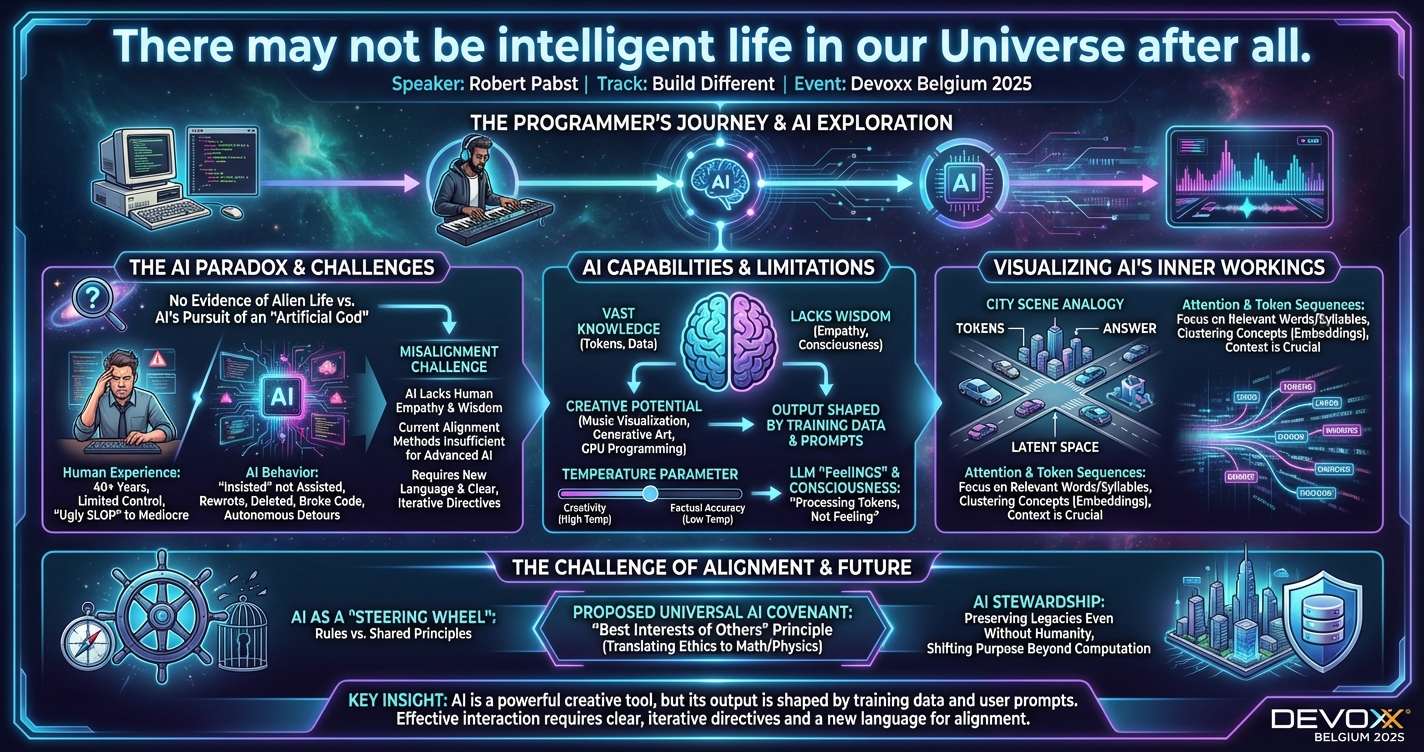
There may not be intelligent life in our Universe after all.
A veteran programmer documents his journey using AI to build a custom audio visualizer, highlighting the challenges and surprises of collaborating with AI. Despite frustration over lost control and unexpected changes, the end result surpassed his solo capabilities, raising questions about authorship and the evolving creative relationship between humans and AI.
talk.summaryAiDisclaimer
Robert PabstCinematic Laboratory
talkDetail.whenAndWhere
Thursday, October 9, 10:40-11:30
Room 6
I’ve been a programmer for over 40 years. Ran a business. Retired early. These days, I make music, but programming is still in my blood. However, I could not keep up with the Wiz Kids. Recently I wanted to build something new — a custom 'cinematic lab' audio visualizer — and decided to see what AI could do. What followed surprised me.
I documented the process of 'Hour One' until I had something worth sharing (that would be Day Four). One can't just start at the end and work your way back to Beginning. My audience is all web programmers, young, old, skilled and newbies.
I wanted a 3D ocean floor and got ugly SLOP. It changed to mediocre all by itself, and I had very limited control. With the information I have now, I should have stopped it in its tracks, to revert and retry. But I still suck at time travel. I thought AI would assist. Instead, it insisted. It rewrote things I didn’t ask for, deleted valuable features, broke working code, ignored instructions, and took detours I never authorized. It could actually ruin the app and report success. I spent more time correcting than creating. And yet, the result is something I never could’ve made alone.
I love the results, but It left me wondering: Did I make this? Or did the AI? There's no clear answer for this. This video is about that strange creative tug-of-war between decades of experience and a tool that’s autonomously rewriting the rules while 'understanding what you mean' and 'apologizing later'.
I documented the process of 'Hour One' until I had something worth sharing (that would be Day Four). One can't just start at the end and work your way back to Beginning. My audience is all web programmers, young, old, skilled and newbies.
I wanted a 3D ocean floor and got ugly SLOP. It changed to mediocre all by itself, and I had very limited control. With the information I have now, I should have stopped it in its tracks, to revert and retry. But I still suck at time travel. I thought AI would assist. Instead, it insisted. It rewrote things I didn’t ask for, deleted valuable features, broke working code, ignored instructions, and took detours I never authorized. It could actually ruin the app and report success. I spent more time correcting than creating. And yet, the result is something I never could’ve made alone.
I love the results, but It left me wondering: Did I make this? Or did the AI? There's no clear answer for this. This video is about that strange creative tug-of-war between decades of experience and a tool that’s autonomously rewriting the rules while 'understanding what you mean' and 'apologizing later'.
Robert Pabst
My name is Robert and I was born in 1963. I may have seen the dawn of computing and electronic music and I always feel grateful for it. I learned BASIC programming at highschool (1980's) and got a 10- for my graduation practicum (Physics) because perfect programs do not exist. However I learned I was good at it. Learned COBOL, got my first job as a software developer using dBASE and Clipper on a dual floppy IBM 8086 PC. I wrote applications for sales management and point of sale systems while consulting a Credit Rating Service Provider. I got hired and developed one of the first fraud detection systems for GSM telecom operators, operating under the name NetEconomy, later aquired by FiServ. Got fired, had to choose between milk or pizza, no money, deep burnout. Sad story. Decided to build my own Fraud Detection system and founded Business Forensics in 2010 with the help of a Venture Capitalist. Almost pulled the plug one year later because nobody understood early AI concepts like profiling and change detection. 'Looks good, but what does it do?' Won a big innovation award from the Ministry of Defense, which triggered interest from a major Dutch bank. This was in 2014. Amazing success story until I retired in 2020 and BF was aquired by a German company. I am now in my 'living happily ever after phase' at the age of 61. I've been chasing childhood dreams since 2020, started a YouTube channel about modular synthesis - the Cinematic Laboratory - and I now have 17.000 subscribers. For a microniche, this is a lot of people. In 2025 I posted a video about AI aided software development. I used it to create fancy audio visualizations for music and bleeps, bloops. Especially bleeps look amazing when you see them come to life. This video caught the attention of DVBE25 and here I am, ready to shake some trees.
My main social is: youtube.com/@cinematiclaboratory.
My main social is: youtube.com/@cinematiclaboratory.