 GenAI & Beyond
Lunch Talk40min
The Invisible Monster: The Carbon Footprint of AI
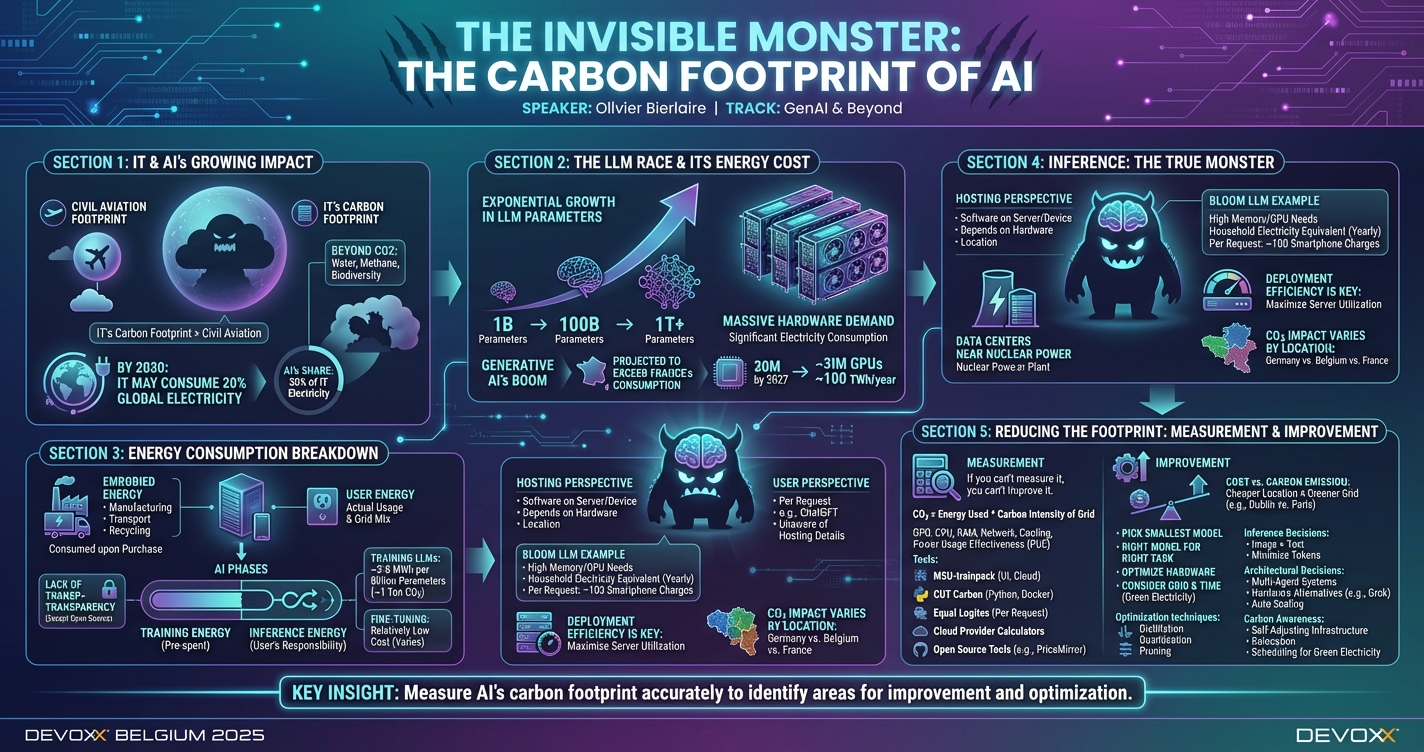
The text highlights the significant carbon emissions generated by AI models like GPT-3.5, equating training emissions to 800 Paris-New York flights. It stresses the need to measure, understand, and reduce AI’s environmental impact through better practices and tools, while still leveraging AI’s benefits for progress.

Olivier BierlaireRebase.Green
talkDetail.whenAndWhere
Tuesday, October 7, 12:40-13:20
Room 4
What is silent, colossal, and terrifying? No, it's not the monster under your bed, it's much worse: the carbon emissions of AI! To confront this monster, we must first understand it: what is the impact of generative AI and LLMs?
We estimate that training GPT-3.5 generated CO2 emissions equivalent to 800 Paris-New York flights. But what about the queries? Should I avoid using it to limit my carbon footprint? If I use an AI assistant for coding, like GitHub Copilot or CodeWhisperer, does it emit a lot of CO2?
Moreover, everyone wants to create their own LLM or generative AI. What is the impact of training, fine-tuning, and using these models? Many companies are concerned about their carbon footprint, and the development as well as the use of AI have an impact that needs to be measured and reduced.
With good hosting practices, GreenOps, and available tools, we can shed light on this issue and help reduce our carbon footprint while benefiting from AI advancements. Finally, I will tell you a dark curtain story that might help us.
Let's discover how to confront this invisible monster together!
We estimate that training GPT-3.5 generated CO2 emissions equivalent to 800 Paris-New York flights. But what about the queries? Should I avoid using it to limit my carbon footprint? If I use an AI assistant for coding, like GitHub Copilot or CodeWhisperer, does it emit a lot of CO2?
Moreover, everyone wants to create their own LLM or generative AI. What is the impact of training, fine-tuning, and using these models? Many companies are concerned about their carbon footprint, and the development as well as the use of AI have an impact that needs to be measured and reduced.
With good hosting practices, GreenOps, and available tools, we can shed light on this issue and help reduce our carbon footprint while benefiting from AI advancements. Finally, I will tell you a dark curtain story that might help us.
Let's discover how to confront this invisible monster together!
Olivier Bierlaire
Founder and CTO of Rebase.Green. Ex-first dev team of Canva, I've worked at Elastic, and now focused on founding in sustainability in IT. With Rebase.green we focus on reducing energy waste in software industry. Based in Nantes, France.
I am a regular speaker at tech conferences across Europe talking about sustainability in cloud computing.
I am a regular speaker at tech conferences across Europe talking about sustainability in cloud computing.
talkDetail.transcript.loginToSeeTakeaways
talkDetail.transcript.loginToSeeInsights
comments.speakerNotEnabledComments