Development Practices
Tools-in-Action30min
Coding challenge: AI-test vs PI-test
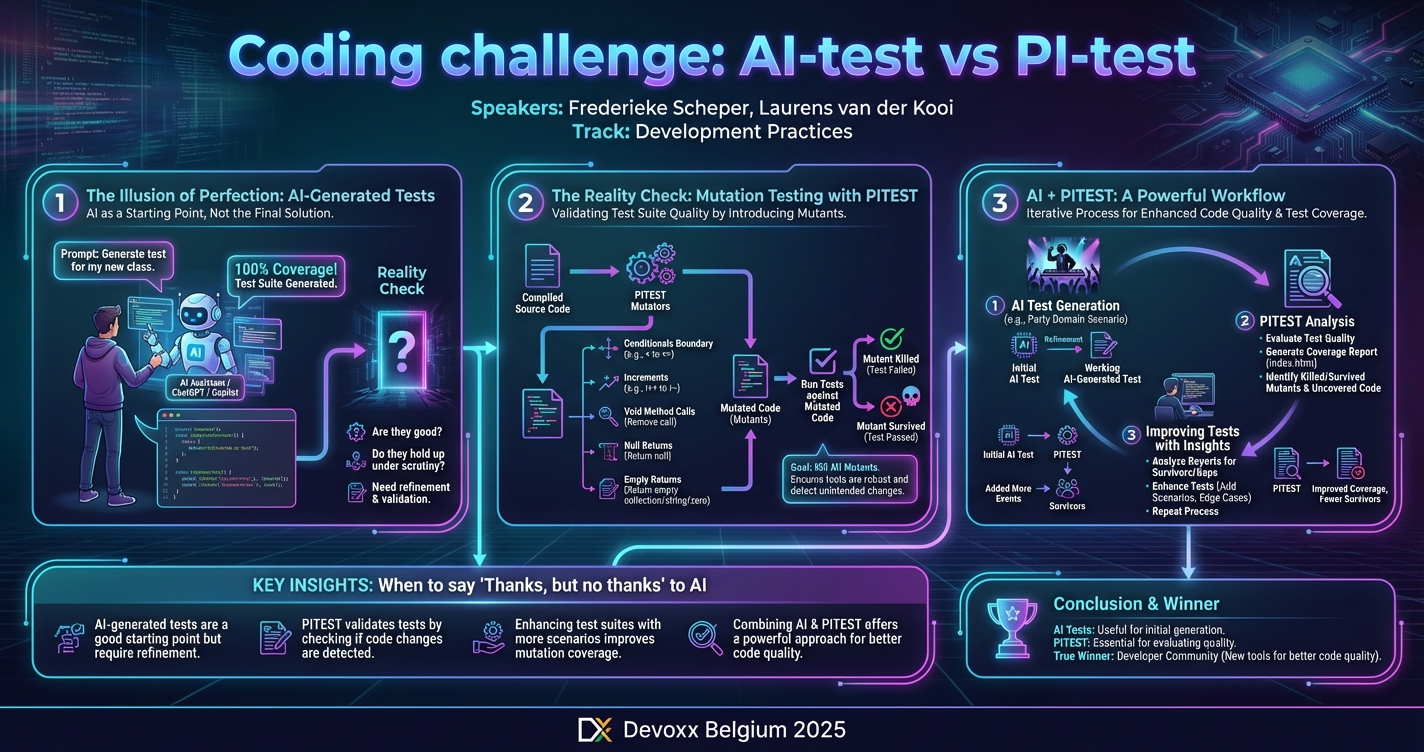
This session evaluates the effectiveness of AI-generated tests using mutation testing and the PI-Test framework, examining whether high coverage equates to quality. Attendees will learn when to trust AI-written tests and when manual test creation is preferable, gaining practical insights into AI-assisted testing practices.
talk.summaryAiDisclaimer

Frederieke ScheperSopra Steria Nederland

Laurens van der KooiSopra Steria
talkDetail.whenAndWhere
Tuesday, October 7, 16:50-17:20
Room 9
Let's be honest: every developer loves writing tests, right? Meaning that we're all diligently practicing Test-Driven Development (TDD), not just preaching it. Or... are we? Maybe that's why we keep asking our AI coding assistants to write tests for us. Just prompt ChatGPT to generate a test for your latest class and voilà: "Of course I can help you write your tests. Here's a complete test suite that achieves 100% line and branch coverage."
But does that really mean the tests are any good?
In this session, Laurens and Frederieke will push AI-generated tests to their limits using mutation testing and the PI-Test framework. Together, we'll explore whether these tests truly hold up under scrutiny, or if they just look good on paper.
By the end, you'll know when to say to your coding assistant, "Thanks, ChatGPT, that was helpful," and when to say, "Thanks, but no thanks. I'll write my own test this time."
But does that really mean the tests are any good?
In this session, Laurens and Frederieke will push AI-generated tests to their limits using mutation testing and the PI-Test framework. Together, we'll explore whether these tests truly hold up under scrutiny, or if they just look good on paper.
By the end, you'll know when to say to your coding assistant, "Thanks, ChatGPT, that was helpful," and when to say, "Thanks, but no thanks. I'll write my own test this time."
Frederieke Scheper
With over 20 years of enterprise Java experience, Frederieke has seen (and probably debugged) it all, from legacy monoliths to reactive messaging systems and the occasional front-end adventure. She’s especially interested in how Domain-Driven Design and reactive principles can help teams build systems that are both robust and adaptable.
Frederieke enjoys helping people grow, whether that’s through mentoring, improving team practices, or just asking the right questions. Outside of work, she’s an active contributor to the Java Meetup in Groningen (NL), where she shares ideas and learns from colleagues in her local community.
When she’s not coding or speaking, you’ll likely find her out on a trail. She once hiked the Grand Canyon and is always looking for the next adventure.
Frederieke enjoys helping people grow, whether that’s through mentoring, improving team practices, or just asking the right questions. Outside of work, she’s an active contributor to the Java Meetup in Groningen (NL), where she shares ideas and learns from colleagues in her local community.
When she’s not coding or speaking, you’ll likely find her out on a trail. She once hiked the Grand Canyon and is always looking for the next adventure.
Laurens van der Kooi
Laurens van der Kooi is a Senior Java Software Consultant at Sopra Steria JTech, passionate about the Spring Framework and Functional Programming. He specializes in building scalable, maintainable Java applications and actively contributes to the developer community through writing technical articles, delivering tech talks, and leading hands-on workshops.