UI & UX
Conference40min
Orchestrating payments for the millions
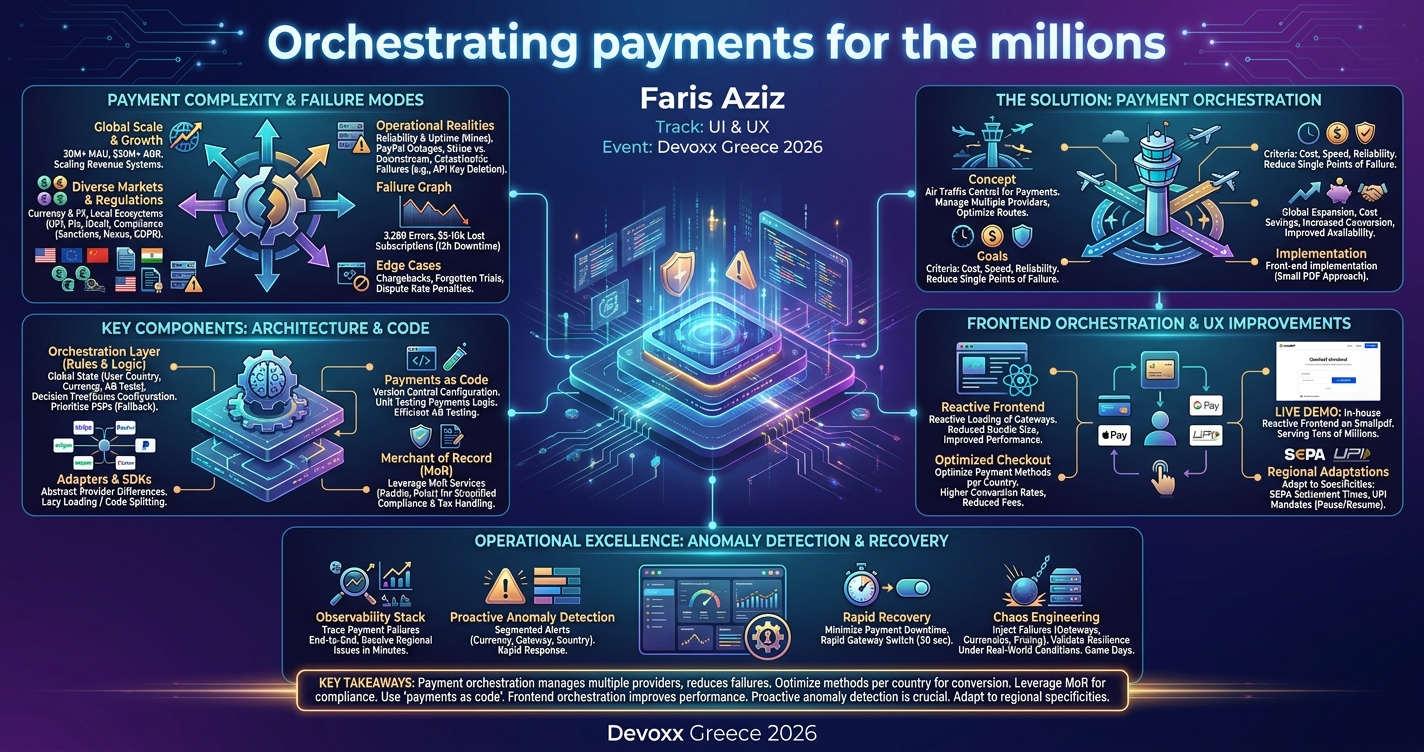
This talk details the architecture and technical strategies behind monetizing a global SaaS platform for 30M+ users, covering payment routing, pricing, and currency challenges. It highlights observability, operational improvements, chaos engineering for resilience, and concludes with a live demo of a production-ready, in-house orchestration system at Smallpdf.
talk.summaryAiDisclaimer

Faris AzizSmallpdf
talkDetail.whenAndWhere
Saturday, April 25, 09:45-10:25
Banquet
This talk goes deep into the architecture behind monetizing a global SaaS platform at scale. I walk through the real technical decisions that support 30 million monthly active users and more than 30 million ARR, covering payment routing, pricing logic, currency handling, and operational realities across wildly different markets and regulatory environments.
I break down the failure modes and edge cases that most teams hit when they scale revenue systems, and share the patterns that turned instability into predictable, observable revenue. We look at the observability stack that lets us trace payment failures end to end and resolve regional issues in minutes, the operational gains from simplifying orchestration, and the DX improvements that let us experiment aggressively without breaking revenue.
We also explore our work applying chaos engineering to monetization, intentionally injecting failures in payment gateways, currencies, and pricing resolution to validate resilience under real-world conditions.
The best part? I’ll end with a live demo of this running in production on Smallpdf, where we built and shipped our in-house reactive frontend orchestration system in React, now serving tens of millions of users worldwide.
I break down the failure modes and edge cases that most teams hit when they scale revenue systems, and share the patterns that turned instability into predictable, observable revenue. We look at the observability stack that lets us trace payment failures end to end and resolve regional issues in minutes, the operational gains from simplifying orchestration, and the DX improvements that let us experiment aggressively without breaking revenue.
We also explore our work applying chaos engineering to monetization, intentionally injecting failures in payment gateways, currencies, and pricing resolution to validate resilience under real-world conditions.
The best part? I’ll end with a live demo of this running in production on Smallpdf, where we built and shipped our in-house reactive frontend orchestration system in React, now serving tens of millions of users worldwide.
Faris Aziz
Faris Aziz is a Staff Frontend Engineer specializing in React, Next.js, monetization systems, and resilient web architecture. He's led teams in early-stage startups and scaling companies, built career ladders from scratch, and shipped systems used by millions. His work spans greenfield builds and legacy refactors across Fintech, SaaS, Fitness, and Connected TV, with companies like Smallpdf, Fiit, Discovery, GCN, and Navro. He focuses on building performant, user-centric applications with solid observability and maintainability. Faris co-organizes ZurichJS, contributes to tools like Raycast, and spends time contemplating life's great questions, like why the build works on his machine but nowhere else.