 Agentic Engineering & Tooling
Deep Dive180min
Don’t burn your fingers in the heat of the AI (r)evolution. (And get an OpenClaw).
The talk explores how to make agentic AI enterprise-ready by shifting key concerns into the platform: security, governance, observability, and boundaries. It covers practical patterns like guardrails, CDC, service mesh, sandboxing, and MLflow tracing to move AI from demo to production safely.
talk.summaryAiDisclaimer
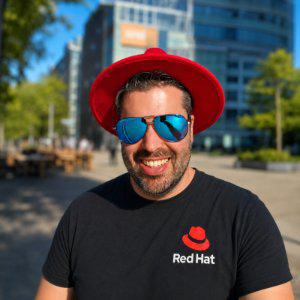
Maarten VandeperreRed Hat
talkDetail.whenAndWhere
Tuesday, October 6, 13:30-16:30
Room 4
“You get an OpenClaw, you get an OpenClaw, and you get an OpenClaw.” (And you’ll get an OpenClaw). What sounds like a joke is actually an experiment: can we make agentic AI available at enterprise level, with the security, governance, observability, and platform boundaries needed to make it safe?
AI demos are easy. Getting them into production is where things usually break: security, data, observability, ownership, governance, and all the boring-but-important platform work. This talk is about the patterns you need to avoid becoming part of the 95% that never make it past the demo stage. And although we use AI as the example, most of these patterns are just as useful for application modernization.
We will deep dive (with demos!) into the underlying platform patterns: agentic guardrailing, change-data-capture, service mesh, model-as-a-service, sandboxed AI environments, and MLflow with tracing enabled. We asked developers to shift left for years, but maybe it is time to shift right as well: push the right responsibilities back into the platform, where they can be standardized, automated, governed, and reused.
Let’s embrace AI in an enterprise context.
Maarten Vandeperre
Maarten Vandeperre is an experienced software professional who recently joined Red Hat as an Appdev & AI Specialized Solutions Architect. With a strong background in software development and architecture, he brings a wealth of expertise to his role. Maarten's primary focus is on application development and AI, with a particular emphasis on leveraging Red Hat's OpenShift platform from a developer's perspective.
One of Maarten's true passions lies in advocating for "clean architecture" as a guiding principle in software development. He firmly believes in the importance of designing software systems that are modular, maintainable, and scalable. As part of his dedication to this approach, Maarten strives to map these principles to infrastructure solutions, ensuring that the underlying technology supports and enhances the overall architecture. His deep understanding of integration technologies, such as API Gateways, Keycloak, Kafka, service mesh, and Camel, enables him to create seamless connections between systems while adhering to clean architectural principles, which empower organizations to thrive in the ever-evolving digital landscape.
One of Maarten's true passions lies in advocating for "clean architecture" as a guiding principle in software development. He firmly believes in the importance of designing software systems that are modular, maintainable, and scalable. As part of his dedication to this approach, Maarten strives to map these principles to infrastructure solutions, ensuring that the underlying technology supports and enhances the overall architecture. His deep understanding of integration technologies, such as API Gateways, Keycloak, Kafka, service mesh, and Camel, enables him to create seamless connections between systems while adhering to clean architectural principles, which empower organizations to thrive in the ever-evolving digital landscape.